
How Outdoor Pool Heaters Work Complete Beginner-to-Expert Guide
Outdoor swimming pools are a luxury, though, unless they are heated, they are not used to their full potential much of the year. It is important to have a clear picture of how outdoor pool heaters operate to make smarter purchasing choices, as well as enable you to run, maintain, and achieve the maximum out of your system to make it as comfortable and efficient as possible. We will begin with the fundamentals and progress to the science, real-world implementation, and high-performance aspects.
Understanding How Outdoor Pool Heaters Work
What Is an Outdoor Pool Heater?
An outdoor pool heater is a mechanical device that is intended to increase and keep the temperature of your swimming pool water independent of the weather conditions outside. The principle works through the removal of water in your pool, its heating via a particular source of heat (gas, electricity, solar energy, or ambient air), and its subsequent release into your pool. It takes place since this cycle increases the temperature of the water gradually to the level that you want.
Fundamentally, a pool heater does not heat a whole pool at a time; instead, it heats little portions of water, in a loop, repeatedly throughout the system before the whole pool has been heated to the intended temperature.
Why Outdoor Pool Heaters Are Important
Outdoor pools lose excess heat to the wind, evaporation, cold nights, and a shady environment. The temperature of the pool is subject to wide variation since the pool lacks a heater, which is why it is quite uncomfortable and even unsafe to swim in the pool. The pool heater balances the temperature of the water and increases the season of the swimming season and making it always comfortable.
In the case of the homes, this translates to increased usability of the pool. In the instance of hotels, schools, and sporting structures, it becomes a stable operation without any inconveniences, weather-related.
Do You Really Need an Outdoor Pool Heater?
You usually require the use of the outdoor pool heater when:
- Your area is cool at night or under seasonal temperature changes.
- You would like to swim all year round.
- The pool is to be used in training, therapy, or swimming for the children.
- You have a business pool that needs regular maintenance.
Even in warm weather, water can cool down quickly by the wind and at night, and heaters will be useful even in hot areas.
Indoor vs Outdoor Pool Heating Differences
Heaters of indoor pools are forced to work under the conditions of controlled conducting areas with low heat loss. On the contrary, outdoor swimming pools lose heat constantly through:
- Wind-driven evaporation
- Cold ambient air
- Nighttime radiation loss
- Rain and cloud cover
Consequently, outdoor pool heaters are forced to exert more effort, be adequately sized, and in most cases have extra specifications such as pool covers to help the heat remain enclosed effectively.
The Science Behind How Outdoor Pool Heaters Work
In order to get a real picture of how outdoor pool heaters operate, it would be vital to first get an overview of the simple science that would guide the movement of heat and the regulated temperature.
How Heat Transfer Works in Pool Heating
All pool heaters can be based on three methods of heat transfer:
- Conduction: Direct conduction between hot surfaces and cooler water (inside heat exchangers).
- Convection: This is a movement of heated water as it returns to the pool.
- Radiation Minor heat exchange between hot parts and adjacent water or air.
These principles cause your heater to take energy as fuel, electricity, sunlight, or air and transfer it into the water.
How Water Is Heated and Re-Circulated of Water
Water is forced through the circulating pump, which pulls out the water in the pool:
- The filter (to remove debris)
- Internal heat exchanger of the heater.
- Reverse into the pool using return jets.
This process takes place until the required temperature is achieved. With every pass, a little amount of heat is introduced, and in the end, the whole pool becomes homogenised.

Role of Pool Pumps in the Heating Process
The heart of the whole heating system is the pool pump. Without proper water flow:
- The heat exchange becomes inefficient.
- There is a possibility of overheating of the heater.
- The system can be brought down by safety sensors.
Having the correct pump size and flow rate is important to the correct operation of the heaters and equipment.
How Thermostats Control Pool Temperature
The thermostats are temperature controllers. You select the temperature of the water you want, and the thermostat:
- Switches on the heater when the water is too cold.
- Switches off when the temperature has reached the target.
Advanced models have digital sensors to provide continual fine-tuning of heat output in order to achieve precise control of heat output and also to save energy.
How Heat Is Lost in Outdoor Pools
Losses in outdoor pools can be due to:
- Evaporation (the largest source of loss)
- Wind exposure
- Cool nighttime air
- Cold rainwater
It is because of this continuous loss of heat that heaters must be used relatively often unless they are supplemented with thermal pool covers and an appropriate time to circulate.
Types of Outdoor Pool Heaters and How They Work
Various types of heaters are used to heat the pool water in various ways, and by knowing these variations, you will be able to place the correct system to suit yourself.
How Gas Outdoor Pool Heaters Work
Gas heaters utilise natural gas or propane, which is burned in a combustion chamber. This heat causes heating of a metal heat exchanger that gives direct transfer of thermal heat to the circulating pool water.
- Island power: Propane or natural gas.
- Speed of heating: Very fast
- Speed of heating: Very fast
- Efficiency level: Moderate
These heaters will be ideal for the rapid increase in temperature and on-demand availability to heat, regardless of the temperature outside.
How Electric Pool Heaters Work
Electric heaters use heating components that are electrically-driven (such as water heaters). Water is made to fall over these elements, and the water collects heat and is returned to the pool.
- Heating process: Resistance to electricity
- Power source: Power grid
- Speed of heating: Moderate
- Level of efficiency: Moderate-high (but costly to operate)
They are better applied in smaller pools or warmer climates where the need for heating is less.
The Solar Outdoor Pool Heater: The Process
The solar heater runs off a roof-mounted solar collector, which is capable of receiving warmth from the sun. Such collectors are used to circulate the water in the pool and warm it naturally, and pump it back into the pool.
- Heating technique: Solar energy.
- Energy source: Sunlight
- Speed of heating: Slow
- Level of efficiency: Very high (near-zero cost of operation)
They are cheap in the long run and completely reliant on the availability of sunlight.
How Heat Pump Pool Heaters Work
Heat pumps use refrigerant gas and compression processes to take thermal energy available in the air around and introduce it to the pool water.
- Heating means: Air-to-water heat transfer.
- Energy supplier: Electricity + ambient heat.
- Speed of heating: Moderate
- Efficiency level: Very high
They are among the most energy-saving alternatives for regular outdoor heating in mild climatic conditions that are warm.

Step-by-Step Process of How Outdoor Pool Heaters Work
The following is what occurs in real time when your heater is on:
Step 1: Water Intake from the Pool
Cooler water in your pool is pumped into the circulation pump through skimmers and bottom drains.
Step 2: Filtration Pre-Heating
Water goes to the filter before reaching the heater to eliminate debris that may break internal heater parts.
Step 3: Heating Through the Heat Exchanger
Within the heater, water passes through a heat exchanger in which it takes the energy of the fuel source, heating elements, sunshine, or air.
Step 4: Control of temperature
Water temperature is adjusted to your thermostat by sensors. The heating unit is automatically adjusted.
Step 5: Heated Water Returns to the Pool
The warm water returns with jets, which increases the overall temperature of the pool slowly by slowly.
Energy Efficiency and Power Consumption of Outdoor Pool Heaters
How Much Energy Do Outdoor Pool Heaters Use
Energy use depends on:
- Pool size
- Temperature difference
- Heater type
- Weather conditions
- Operating hours
Gas heaters burn the highest amount of fuel, and solar virtually none of the fuel.
What Affects Heating Efficiency
Efficiency is influenced by:
- Wind exposure
- Pool covers
- Water flow rate
- Filter cleanliness
- Heater sizing accuracy
How Long ItTakes to Heat an Outdoor Pool
On average:
- Gas heaters: 1–2°F per hour
- Heat pumps: 0.5–1°F per hour
- Solar heaters: hours to days
How to Reduce Pool Heating Costs
You will save a lot of money on heating by:
- Using a solar blanket
- Daylight heating.
- Maintaining clean filters
- Selecting the appropriate size of the heater
Real-World Applications of Outdoor Pool Heaters
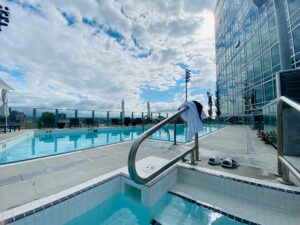
The outdoor pool heaters can be used in various organisations and settings with various purposes:
- Homes: Luxury year-round swimming.
- Resorts and Hotels: Customer satisfaction and high-quality experience.
- Schools and Gyms: Training and therapy pools.
- Cold vs Hot Climates: Stabilising vs extending the season.
Applying systems within each application needs varying system sizing and efficiency priorities.
Common Problems That Affect How Outdoor Pool Heaters Work
- Heaters can be switched off because of low water or sensor problems.
- Sometimes, short cycling is a result of faulty thermostats or undersizing of equipment.
- Dirty filters, oversized heaters, or cold weather can cause slow heating.
- Clogged filters limit the flow and heat exchange.
- Severe weather has a direct effect on performance, particularly on solar and heat pumps.
Outdoor Pool Heater Safety Information
- Electrical safety: It must have good ground and water-resistant connections.
- Gas safety: It should be well ventilated, and leakages should be spotted.
- Child safety: Access denial to equipment.
- Scalding prevention: Temperature restrictions should be imposed.
Why Proper Maintenance Makes Outdoor Pool Heaters Work
- Clean filters weekly
- Check heat exchangers to see if they are scaled.
- Flush systems seasonally
- Annual test on gas leaks, wiring faults, and flow problems.
FAQs
What is the time of heating an outdoor pool?
12-72 hours, depending on heater type and temperature difference.
Are outdoor pool heaters operational in the winter season?
Yes- gas and heat pump heaters in particular.
Which outdoor swimming pool heater is the most energy-saving?
The most efficient ones are solar heaters and heat pumps.
Can outdoor pool heaters be on the entire day?
Yes, when it is the proper size and taken care of.
Are solar outdoor pool heaters effective at night?
No, however, it is possible to keep stored daytime heat overnight with a pool cover.
Conclusion
The functioning of the outdoor pool heaters helps to select the right system for the pool and climate. These heaters may be utilized to warm the water and maintain the water at a comfortable swimming temperature by exchanging the heat of gas, electricity, or even the sun, and extend your swimming season. A pool heater will add comfort, performance, and overall enjoyment to the pool when it is installed and properly maintained.